Preschool Shape Tracing Worksheets
In the landscape of early childhood development, few tools offer as much immediate utility and long-term value as Preschool Shape Tracing Worksheets. These are not merely pages filled with geometric figures; they represent a foundational component in a structured learning workflow. For educators managing classrooms, parents orchestrating home routines, or content creators developing educational resources, understanding the operational mechanics of these worksheets is essential. They serve as a critical bridge between unstructured play and formal academic instruction, specifically targeting the development of fine motor skills required for future writing tasks.
The Operational Value of Shape Tracing in Early Development
Before integrating these materials into a daily routine, it is important to understand the underlying process. The act of tracing paths, lines, and patterns is a complex neurological and physical task for a child aged three to five. When a child grips a crayon and follows a dotted line, they are engaging in a specific type of hand-eye coordination that directly correlates to pre-writing skills. This activity strengthens the small muscles in the hands and fingers, building the dexterity necessary to hold a pencil correctly later on.
From a planning perspective, these worksheets function as a low-friction entry point into literacy preparation. Unlike complex lesson plans that require extensive setup, Preschool Shapes Tracing Worksheets for Pre-K are designed for immediate deployment. They allow teachers to transition quickly from free-play time to focused instruction without losing student engagement. The repetitive nature of tracing shapes provides a predictable environment where children can practice precision without the cognitive load of decoding new information, making them ideal for reinforcing concepts during morning work or learning center rotations.
Integrating Worksheets into Educational Workflows
Successful implementation of any educational resource depends on how seamlessly it fits into existing workflows. Whether you are a classroom teacher organizing a week's worth of activities or a homeschooling parent structuring a day, the versatility of high-quality tracing sheets is a significant asset. The "No Prep, Ready-to-Go" nature of these digital assets means they eliminate the administrative overhead often associated with creating custom materials. You can print a sheet and immediately begin an instructional session, which is crucial for maintaining momentum in a busy schedule.
These worksheets interact effectively with various other teaching tools and methods. In a learning center setting, they can be paired with manipulatives like pattern blocks or magnetic shapes. A child might trace a circle on the worksheet while simultaneously stacking circular rings, reinforcing the concept through multiple sensory channels. Similarly, when used at-home, these files can be integrated into a broader curriculum that includes storytelling or art projects. After tracing a square, a child might be asked to find four square objects in the room, bridging the gap between abstract symbols and real-world application.
Strategic Placement in Daily Routines
The timing of when these activities occur matters as much as the activity itself. Because tracing requires focus but not necessarily high-energy output, it is perfectly suited for transitional periods in a child's day. It serves as an excellent calming activity after recess or a structured way to start the day before more demanding academic tasks. For professionals managing multiple students, this consistency allows for a predictable rhythm. Students know what to expect, which reduces anxiety and behavioral issues, allowing the educator to focus on individual guidance rather than crowd control.
In a professional context, such as a tutoring business or a freelance educational consulting role, offering these ready-made resources adds tangible value to your service package. Clients appreciate efficiency. By providing high-resolution, printable assets, you demonstrate an understanding of the logistical challenges parents face. It shifts the dynamic from "creating work" to "facilitating learning," positioning you as a partner in their child's development rather than just an instructor.
Technical Specifications and Quality Control
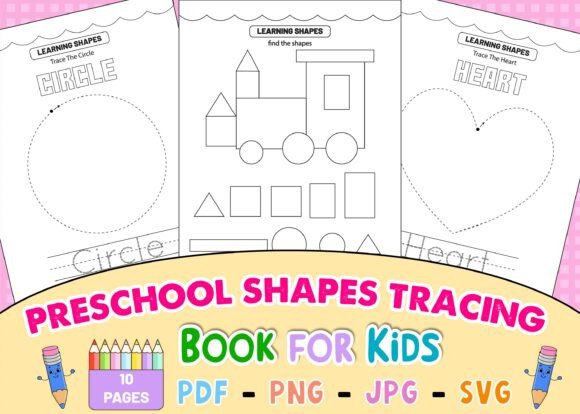
When sourcing or creating digital educational assets, technical specifications are not just details; they are quality control measures. The availability of Preschool Shape Tracing Worksheets in multiple file formats—specifically JPG, PNG, SVG, and PDF—ensures compatibility across different devices and printing needs. Each format serves a distinct purpose within a digital workflow.
The inclusion of 10 JPG files, 10 PNG files, and 10 SVG files, all at 300 DPI, indicates a robust library designed for flexibility. High resolution (300 DPI) is non-negotiable for print media. If a file is printed at a lower resolution, the lines become pixelated, which can frustrate young learners who are trying to stay within the boundaries. The 8.5″ x 8.5″ size is standard for many classroom printers and home office setups, ensuring that the content fills the page appropriately without requiring awkward scaling or cropping.
However, users must remain aware of the variables involved in the final output. While the source files are high quality, the final print result depends on the printer settings and paper quality. Monitor calibration can cause colors to appear differently than they do on screen, even though these are primarily black-and-white coloring pages. To ensure consistency, it is advisable to perform a test print on standard copy paper before committing to higher-quality cardstock or large batches. This step mirrors the QA processes used in professional publishing, ensuring that the end product meets the intended standard.
File Format Utility
- PDF: The single PDF file is the most versatile option for direct printing. It preserves layout integrity and is universally compatible with standard printers.
- PNG & JPG: These raster formats are ideal for displaying the worksheets on tablets or interactive whiteboards before printing. They allow for easy sharing via email or cloud storage platforms.
- SVG: Scalable Vector Graphics are valuable for those who wish to edit the designs, resize them without loss of quality, or integrate them into larger graphic design projects. This is particularly useful for creators who want to customize the worksheets for specific branding or thematic units.
Optimizing the Learning Environment
Once the materials are acquired and prepared, the focus shifts to the execution phase. The goal is to create an environment where the child feels supported in their attempts. Providing the right tools is part of this optimization. Alongside the worksheets, ensure that children have access to appropriate writing instruments. Crayons, thick markers, or pencils with ergonomic grips can make the difference between a successful tracing experience and a frustrating one.
Consistency is key to building proficiency. Incorporating shape tracing into a regular schedule helps reinforce neural pathways. However, variety prevents boredom. Since the collection includes ten unique designs, there is ample material to rotate through over several weeks. Educators and parents should track progress by observing changes in stroke control and confidence. Are the lines becoming straighter? Is the child staying within the borders more accurately? These observations provide data points that inform the next steps in the child's learning journey.
For entrepreneurs and publishers looking to leverage this content, the potential extends beyond simple usage. The high-quality nature of these assets makes them suitable for bundling into larger educational kits, selling as standalone downloads on digital marketplaces, or using as lead magnets to build an email list for educational products. The versatility of the 300 DPI files ensures they meet professional standards, enhancing the credibility of any brand that distributes them.
Conclusion on Implementation
Ultimately, Preschool Shape Tracing Worksheets are more than just a collection of images; they are a strategic tool for fostering developmental milestones. By understanding their role in fine motor skill acquisition and integrating them thoughtfully into daily routines, adults can significantly boost a preschooler's readiness for formal schooling. The combination of high-resolution digital files, diverse format options, and a "no-prep" philosophy makes these resources an efficient addition to any educational toolkit. Whether used in a bustling classroom, a quiet home study, or as part of a commercial educational product, the impact is clear: a smoother path toward writing competence and confident learning.